Shakespeare’s Sonnets are some of the most fascinating and influential poems written in English. First published in 1609, in a small quarto edition (roughly the size of a modern paperback), almost nothing is known about the poems’ composition. But the Sonnets have been read, recited, […]
Archivi Giornalieri: 21 Ago 2023
«Take all my loves, my love, yea, take them all; What hast thou then more than thou hadst before?». Sonnet 40 begins a three-sonnet sequence in which the poet shares his possessions and his mistress with the youth, although it is not until Sonnet 41 […]
«O, how thy worth with manners may I sing, When thou art all the better part of me?». Sonnet 39 constructs an ingenious variation on the theme of absence. Ironically, separation is inspirational: “That by this separation I may give / That due to thee […]
«How can my Muse want subject to invent, While thou dost breathe, that pour’st into my verse». Like the previous sonnet, Sonnet 38 contrasts the selfishly lascivious youth and the adoring, idealistic poet. The poet appears pitifully unable to contemplate his life without the youth, […]
«As a decrepit father takes delight To see his active child do deeds of youth». Sonnet 37, which echoes Sonnet 36, conveys the emotions of a doting parent and discontinues the confessional mode of the previous sonnets. Sonnet 37 Read and listen As a decrepit […]
«Let me confess that we two must be twain, Although our undivided loves are one». Obstacles to the friendship between the poet and the young man remain, but the poet is no longer wholly duped by his young friend. However, he still maintains that their […]
«No more be grieved at that which thou hast done: Roses have thorns, and silver fountains mud». Whereas in Sonnet 33 the poet is an onlooker, in the previous sonnet and here in Sonnet 35, the poet recognizes his own contribution to the youth’s wrongdoing […]
«Why didst thou promise such a beauteous day, And make me travel forth without my cloak». The poet speaks of a quite different feeling than he did in Sonnet 33. He is puzzled and painfully disappointed by the youth, whose callousness dashes any hope of […]
«Full many a glorious morning have I seen Flatter the mountain-tops with sovereign eye». Sonnet 33 begins a new phase in the poet and youth’s estrangement from each other. (The breach well may be caused by the youth’s seduction of the poet’s mistress, which the […]
«If thou survive my well-contented day, When that churl Death my bones with dust shall cover». Sonnet 32 concludes the sonnet sequence on the poet’s depression over his absence from the youth. Sonnet 32 Read and listen If thou survive my well-contented day, When that […]
«Thy bosom is endeared with all hearts, Which I by lacking have supposed dead». Sonnet 31 expands upon the sentiment conveyed in the preceding sonnet’s concluding couplet, “But if the while I think on thee, dear friend, / All losses are restored and sorrows end.” […]
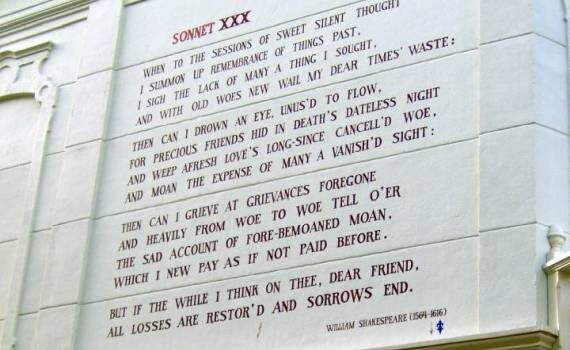
«When to the sessions of sweet silent thought I summon up remembrance of things past». The poet repeats Sonnet 29’s theme, that memories of the youth are priceless compensations — not only for many disappointments and unrealized hopes but for the loss of earlier friends: […]
«When, in disgrace with fortune and men’s eyes, I all alone beweep my outcast state». Resenting his bad luck, the poet envies the successful art of others and rattles off an impressive catalogue of the ills and misfortunes of his life. His depression is derived […]
«How can I then return in happy plight, That am debarr’d the benefit of rest?». Images of absence, continued from the previous sonnet, show the poet at the point of emotional exhaustion and frustration due to his sleepless nights spent thinking about the young man. […]
«Weary with toil, I haste me to my bed, The dear repose for limbs with travel tired». The poet describes himself as being “weary with toil” and trying to sleep. The somber mood announces a new phase in the relationship. In the first four lines, […]
«Lord of my love, to whom in vassalage Thy merit hath my duty strongly knit». Sonnet 26 prepares for the young man’s absence from the poet, although the reason for this separation is not clear. The sonnet’s first two lines, “Lord of my love, to […]